Quick Answer
Irish businesses must keep emergency lighting working so people can leave safely if mains power fails. In practice that means a monthly function test, a full-duration test once a year, and a written log of every test and repair. Systems are normally designed and maintained to Irish standard I.S. 3217, and a competent provider should issue a certificate after the annual test.
What Is Emergency Lighting?
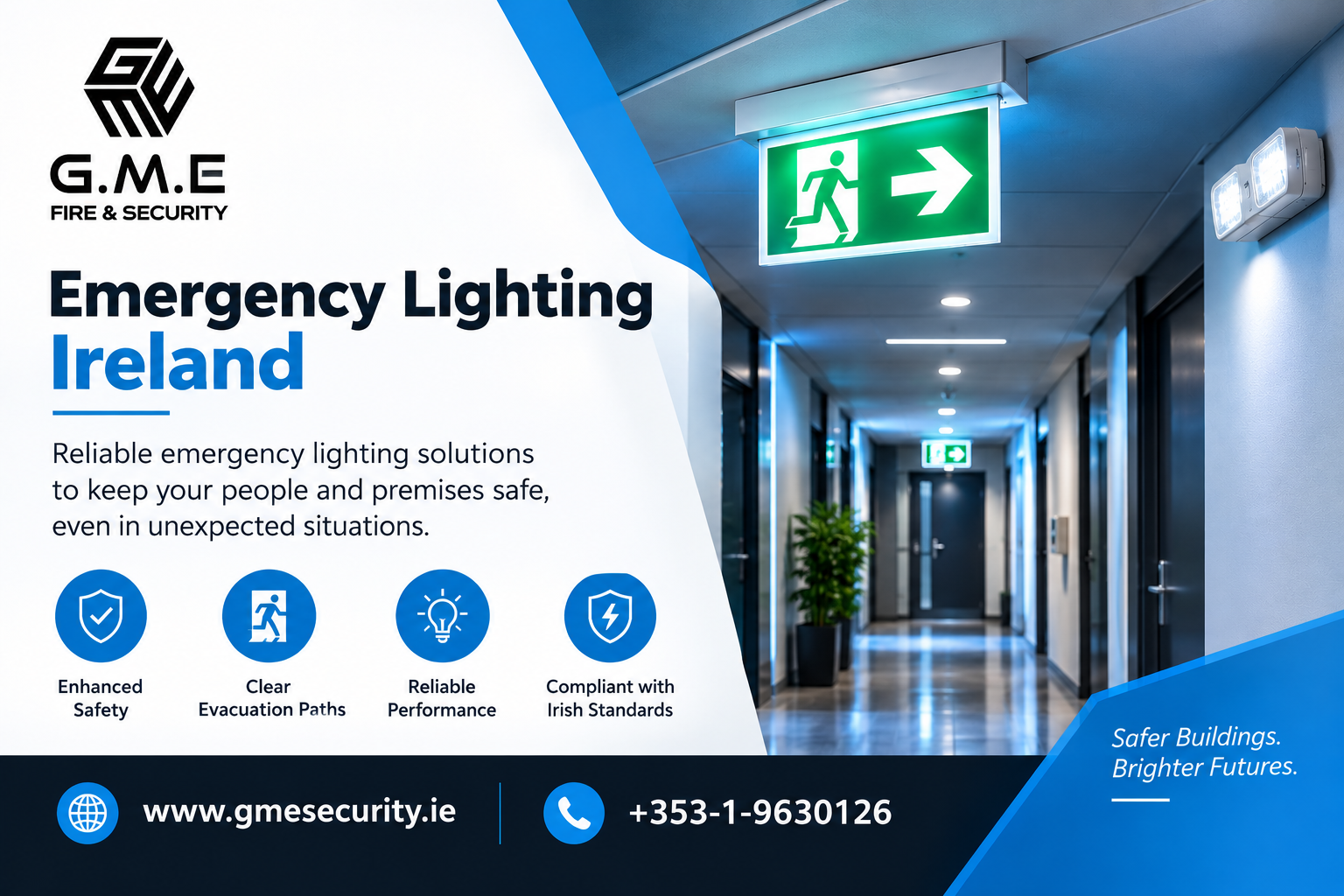
Emergency lighting switches on automatically when the normal lighting fails, whether from a power cut or a fire. It helps people see exits, stairs and obstacles so they can evacuate without panic.
There are two main types:
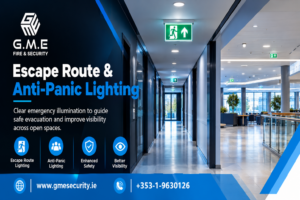
- Escape route lighting: lights corridors, stairs and exit routes so people can reach a safe place.
- Open-area (anti-panic) lighting: lights large rooms such as open-plan offices, warehouses and retail floors, so people can move towards the escape routes.
Most buildings also need illuminated exit signs and extra lighting at fire alarm call points and fire-fighting equipment.
What Do Irish Rules Expect From Businesses?
Under the Fire Services Acts 1981 and 2003, the person in control of a premises must take reasonable measures to protect people from fire. Working emergency lighting is a core part of that duty.
In practice, businesses are expected to:
- Have an emergency lighting system suited to the building layout and use.
- Test it on a regular schedule.
- Keep a log book that records tests, faults and repairs.
- Repair faults promptly and re-test after any work.
- Use a competent person for installation, servicing and certification.
From our experience servicing Irish commercial buildings, the most common problem is not a missing system. It is a system that was installed years ago, never properly tested, and found to fail only when an inspector or a power cut checks it.
If you are unsure which rules apply to your building, a fire inspection and testing visit is the quickest way to find out where you stand.
How Often Should Emergency Lighting Be Tested?
The schedule below is the standard approach for most commercial buildings. Always confirm the exact requirements for your premises with your installer or fire safety adviser
| Test | How often | What it involves | Who can do it |
|---|---|---|---|
| Visual check | Daily or weekly | Look for lights that are off, damaged or blocked | Staff or building manager |
| Function (flick) test | Monthly | Briefly simulate a mains failure and confirm every light and sign comes on | Trained staff or service provider |
| Full-duration test | Annually | Run the lights on battery for their full rated time (often 3 hours) | Competent service provider |
| Certificate and log review | Annually | Record results, faults and repairs in the log book | Service provider and responsible person |
Schedule full-duration tests outside working hours, because batteries need time to recharge afterwards. During that recharge period, the building has reduced emergency cover.
Common Emergency Lighting Faults
Most failures are simple and preventable. These are the ones we see most often:
- Dead or ageing batteries: most last roughly 3 to 5 years, depending on the unit and conditions.
- Failed lamps or LEDs: units that look fine but no longer light.
- Blocked or covered fittings: signs hidden behind shelving, stock or decorations.
- Layout changes: partitions, new rooms or racking added without updating the lighting plan.
- No test records: the system may work, but without a log you cannot prove it.
- Power supply faults: tripped circuits or disconnected units after building work.
A monthly test is what catches these early. Without it, a failed unit can go unnoticed for years.
How to Choose an Emergency Lighting Provider?
Emergency lighting is a safety system, so choose a provider carefully. Look for:
- Experience with commercial buildings similar to yours.
- Clear certification after installation and annual testing.
- A written log book and test reports you can show an inspector.
- Fast repairs, and a re-test once work is complete.
- Support across related systems, so lighting, alarms and detection are maintained together.
At GME Security, our emergency lighting service sits alongside our wider fire safety offering. That includes fire detection, fire alarm monitoring and fire inspection and testing, so one provider can look after your whole system.
If you also want to keep your fire records in order, see our guide to the digital fire register in Ireland. For a wider overview of what your building needs, read our fire detection systems business guide.
Emergency Lighting Needs by Sector
Every building is different, and the risks change with how people use the space:
- Healthcare: patients may need assistance to evacuate, so reliable lighting on every route matters. See healthcare security.
- Education: large numbers of people, long corridors and lecture halls. See educational security.
- Retail and hospitality: unfamiliar visitors, crowded floors and late-evening trading. See retail security and hospitality security.
- Commercial property: multi-tenant buildings where shared escape routes need one clear owner. See commercial property security.
You can see how we approach real sites in our case studies, including the fire alarm system installation for an industrial laundry.
Quick Emergency Lighting Compliance Checklist
- ☐ Every exit route, stair and exit sign has working emergency lighting
- ☐ Monthly function tests are done and recorded
- ☐ A full-duration test was completed in the last 12 months
- ☐ The log book is up to date and easy to find
- ☐ Faults from the last test have been repaired and re-tested
- ☐ Layout changes have been reviewed by a competent person
- ☐ Your provider has issued a current test certificate
Frequently Asked Questions
Q1. Is emergency lighting a legal requirement in Ireland?
Ans. Most commercial and public buildings need it as part of their fire safety measures. The person in control of the premises is responsible for keeping it working. Your fire safety adviser can confirm what applies to your building.
Q2. How often should emergency lighting be tested?
Ans. A short function test every month and a full-duration test once a year are the standard schedule for most commercial buildings.
Q3. How long should emergency lights last on battery?
Ans. The rated duration is usually 1 or 3 hours, depending on the building type and risk. The annual test confirms the batteries still deliver their full rated time.
Q4. Who can test emergency lighting?
Ans. Simple monthly checks can be done by trained staff. The annual full-duration test and certification should be carried out by a competent service provider.
Q5. What should be in an emergency lighting log book?
Ans. Dates of tests, results, faults found, repairs carried out, who did the work and the date of the re-test.
Q6. What happens if my emergency lighting fails a test?
Ans. Repair it as soon as possible, record the fault and the repair in the log book, and re-test. If the failure affects an escape route, treat it as urgent.
Conclusion
Emergency lighting is easy to forget until the day it is needed. A regular test schedule, a clear log book and a competent provider turn it from a hidden risk into a reliable safeguard. If you are not sure when your system was last tested, start there.
Need Your Emergency Lighting Tested or Upgraded?
GME Security installs, tests and maintains emergency lighting and fire safety systems for businesses across Ireland. Contact us for a free consultation or to book an inspection.