
Intruder Alarm Installation at a Commercial Distribution Centre
Protecting high-value stock across a large multi-zone warehouse — with a system comprehensive enough for the insurer and simple enough for the last person locking up at night.
SUMMARY
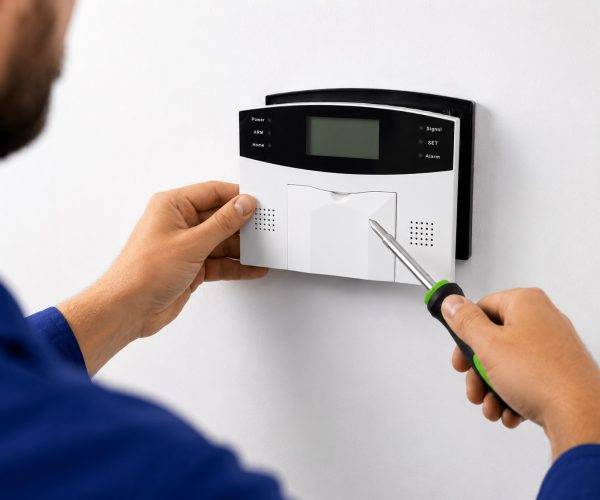
GME Fire & Security surveyed, designed and installed a tailored intruder alarm system across a busy commercial distribution centre covering warehouse, stockholding, office and loading areas. Detection was positioned around genuine vulnerabilities across a complex multi-entrance site, with an HKC control panel giving staff straightforward arming and disarming, and monitored alarm notification for out-of-hours response.
PROJECT AT A GLANCE
| Sector | Logistics and distribution |
|---|---|
| Location | Ireland — Leinster |
| Systems installed | Commercial intruder alarm with HKC control panel and monitored alarm notification |
| Site profile | Warehouse, stockholding areas, offices and loading bays; multiple access points; unoccupied outside operating hours |
| Standards applied | I.S. EN 50131 (intruder and hold-up systems); PSA-licensed installation |
| Delivered by | GME Fire & Security — PSA-licensed, Irish-owned, Garda-vetted engineers |
| Headline outcome | Comprehensive out-of-hours protection with simple daily operation for staff |
The brief: valuable stock, an empty building, and a lot of doors
A distribution centre is one of the harder commercial buildings to secure well. The stock is portable and worth money. The footprint is large. There are goods-in doors, goods-out doors, fire exits, office entrances and yard gates — and for most of the night, nobody is inside.
This client came to GME wanting reliable out-of-hours protection across the whole premises: warehouse, stockholding areas, offices and points of entry. Just as importantly, they needed a system their team could operate correctly every single evening, because an alarm that is awkward to set is an alarm that eventually stops being set.
The challenge
The site survey highlighted several issues with the existing arrangements:
- Insufficient protection against forced entry. Coverage did not reflect where an intruder would actually attempt access.
- Scale and layout. Multiple entry points, high-bay racking, offices and loading areas each behave differently from a detection point of view, and a single generic solution covers none of them well.
- High-value, portable stock. The commercial exposure of a single overnight break-in was significant, and insurers take a close interest in how such premises are protected.
- Operational hours. Staff needed to enter and leave safely during working hours without the alarm becoming an obstacle or generating false activations.
There was also a straightforward business risk sitting behind all of this. Many commercial insurance policies make a monitored, standards-compliant alarm a condition of cover. Where the installed system does not meet what the policy assumes, a claim can be challenged at precisely the worst moment.
What GME did
1
A detailed site survey first
GME engineers surveyed the full premises, working through each zone in turn — perimeter and entry points, warehouse floor and racking aisles, stockholding areas, offices and loading bays. The survey established where an intruder would realistically attempt entry, where they would have to move once inside, and where detection would be reliable rather than nuisance-prone.
2
Detection matched to each zone
Detection devices were positioned to protect vulnerable access points, internal circulation and key operational spaces, with device types selected for the conditions in each area. High-bay warehouse space, an open loading area and a small office corridor demand different detection approaches; treating them identically is the most common reason large-site alarms either miss intruders or cry wolf until staff ignore them.
3
HKC control panel and simple daily operation
An HKC control panel and user interface were installed to give authorised personnel clear, straightforward control of the system. Zones were configured so that areas can be armed independently — securing the warehouse while offices remain in use, for example — and entry and exit routes were set so staff can come and go during operational hours without triggering activations. Nominated key holders were trained on arming, disarming and fault indication.
4
Monitored alarm notification
Alarm notification arrangements were incorporated so that an activation produces a response rather than a noise in an empty industrial estate. Connection to a monitoring centre is what converts an alarm from a deterrent into a protective measure — and it is frequently the specific element an insurance policy requires.
5
Installation around the operation
Works were planned around the distribution centre’s shift and delivery schedule, so warehouse and logistics operations continued with minimal interruption during the installation.
Compliance: what was applied and why it matters
Commercial intruder alarm systems in Ireland should be designed, installed and maintained to I.S. EN 50131, and the installing company must hold a Private Security Authority licence. These are not paperwork exercises. The standard governs grading, detection coverage, signalling and resilience — the difference between a system that performs on the night and one that merely exists.
For a business holding valuable stock, standards compliance is also a commercial safeguard. It is the evidence you produce for an insurer or a broker that the premises were protected as declared.
The result
The distribution centre now has comprehensive, reliable protection across warehouse, stockholding, office and loading areas, and dependable coverage during the long periods when the building is unoccupied.
The client has significantly better control over the security of valuable stock and equipment, with a clear picture of the site’s protection rather than assumptions about it. Staff have a simple, consistent routine for securing the premises at the end of each working day — which is ultimately what determines whether any alarm system delivers on its purpose.
Key benefits at a glance
- Comprehensive protection across warehouse, stockholding, office and loading area
- Detection designed around genuine entry risk on a large, multi-entrance site
- Reliable out-of-hours protection when the building is unoccupied
- Zoned arming so parts of the site can be secured while others stay in use
- Monitored alarm notification for a real response, not just an audible warning
- Straightforward daily operation and trained key holders
- I.S. EN 50131-compliant installation by a PSA-licensed provider — evidence for your insurer
- Installation phased around shift patterns, with minimal operational disruption
Frequently Asked Questions
How is a warehouse alarm different from an office or retail alarm?
Scale and environment change the design entirely. Large open volumes, high-bay racking, forklift movement, temperature variation and loading doors all affect which detection technologies are reliable and where they should be placed. A specification that works well in a small office will typically produce both blind spots and false activations in a distribution centre.
Does our insurance policy require a monitored alarm?
Very often, yes — particularly for premises holding high-value or portable stock. It is worth checking your policy wording directly: if monitoring is listed as a condition and your alarm is not connected to a monitoring centre, your cover may not respond to a claim. This is one of the most common and most expensive gaps we find on commercial sites.
Can we arm part of the building while people are still working?
Yes. A properly zoned system lets you secure the warehouse and stockholding areas while offices remain occupied, then set the remainder at the end of the day. Zoning is worth specifying at design stage — retrofitting it is more disruptive than getting it right at the outset.
What standard should a commercial intruder alarm meet in Ireland?
I.S. EN 50131, installed and maintained by a company licensed by the Private Security Authority. Systems are graded according to risk, so a distribution centre holding valuable stock will generally require a higher grade than a low-risk small office. If nobody can tell you what standard or grade your current system was installed to, that is a finding in itself.
Is your warehouse actually protected — or just alarmed?
GME Fire & Security carries out independent audits and health checks on existing systems, regardless of who installed them, as well as full design and installation. Irish-owned, PSA-licensed, commercial clients only. Free site surveys across Dublin, Kildare, Meath and Wicklow.